Short answer: A chore is easier to complete when the child can see exactly what “done” means. Choose one age-appropriate task, show the finished state, reduce it to a few observable actions, and use one neutral check at the end. Support the start without silently taking over. The goal is not a perfect room or instant independence; it is a repeatable path from cue to completion.
Why “clean up” may not be one task
Adults often experience a chore as one familiar unit: unload the dishwasher, put away laundry, or reset the table. A child may encounter many separate decisions—where to begin, what belongs together, which cabinet to use, how clean is clean enough, and whether the task is actually finished. Attention shifts, weak cues, unclear expectations, and transitions can make that chain harder to hold together.
That does not mean every unfinished chore is caused by ADHD. The task may be too large, unfamiliar, poorly timed, or mismatched to the child’s current skills. Fatigue, stress, learning differences, family conflict, and other health or developmental factors can also matter. Treat the routine as a small environmental experiment, not as a test of motivation or a way to diagnose symptoms.
The American Academy of Pediatrics’ ADHD guideline identifies parent training in behavior management as an evidence-based component of care for children. The CDC describes that training as teaching positive reinforcement, structure, consistent responses, practice, and ongoing adjustment. A home chore routine can borrow those broad principles, but a checklist made at home is not a substitute for a trained clinician or a comprehensive treatment plan.
Build a visible start-to-finish loop
Choose one concrete outcome
Replace “clean your room” with an outcome that can be inspected without debate: dirty clothes are in the hamper, books are on the shelf, or the table is clear and wiped. The American Academy of Pediatrics’ HealthyChildren guidance recommends introducing one new responsibility at a time and keeping expectations realistic. Select a task that is safe and appropriate for the child’s age and abilities.
Show the finish line before the start
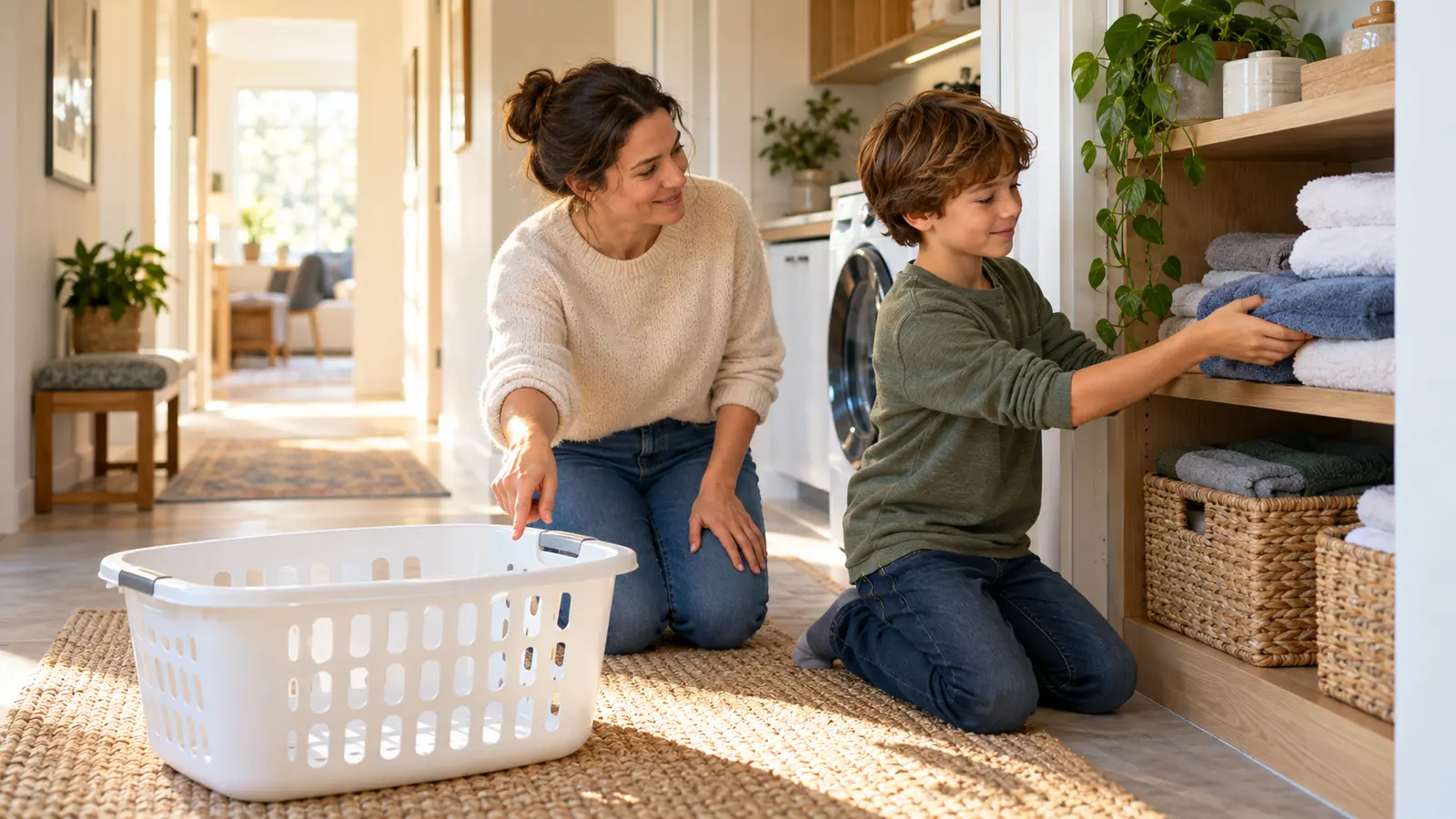
Point to a simple example, a photo of the finished space, or the actual empty basket or clear counter. Use a brief sentence: “Done means every towel is on this shelf and the basket is empty.” A visible endpoint reduces the need to remember a vague verbal standard and makes the final check more objective.
Make the sequence short and observable
Keep the first version to three or four actions. For laundry, that might be: match, fold, place, return the basket. Put the actions where the work happens, using words, pictures, or objects that fit the child. A long chart can become another task to manage. If one step is consistently difficult, teach or practice that step separately.
Support the launch, then fade
Give one clear cue, move with the child to the work area if needed, and help with the first action rather than repeating the entire direction from another room. Then pause. The child may need a model, a choice between two acceptable starting points, or a brief check-in. Reduce support gradually only when the routine is becoming reliable.
Close the loop with evidence
Return to the original finish line: “The shelf is filled and the basket is empty.” Use specific acknowledgment rather than a global judgment of the child. If something remains, point to the agreed outcome and ask what step is left. Completion should end the chore; avoid adding surprise tasks after the child reaches the stated finish line.
A practical example
Task: clear the family table. Finish line: dishes are at the sink, trash is discarded, and the tabletop is empty. Sequence: carry dishes, collect trash, return shared items. Launch support: the parent carries one item with the child, then steps back. Close: both look at the table and name what is complete.
Run a one-week chore trial
Use the same task, cue, sequence, and finish line for one week. Consistency makes it possible to learn the routine and gives the family useful information. Record only what helps: whether the child started after the cue, where support was needed, and whether the finish line was reached. Do not turn the record into a daily character score.
- Keep the cue stable. Link it to an existing event, such as after dinner or before screen time, rather than issuing it at unpredictable moments.
- Offer bounded choice. The child might choose whether to start with towels or socks, while the expected finished state stays the same.
- Adjust one variable. If the routine stalls, shorten the sequence, move materials, or change the cue—not everything at once.
- Protect teaching time. The middle of a rushed conflict is rarely the best moment to introduce a new chore.
- Review together. Ask which step was unclear and what would make the next attempt easier.
HealthyChildren recommends written chore lists, predictable routines, and gradual removal of scaffolding as children become more self-directed. It also cautions families to keep expectations realistic and consider the child’s individual style. Independence is not measured by the absence of all reminders; it grows when support becomes better matched, less intrusive, and easier to fade.
Use rewards carefully and preserve connection
Positive reinforcement is part of many evidence-based behavioral approaches, but a reward is not the whole plan. State the target in advance, keep the response proportionate, and connect acknowledgment to the observable behavior. Avoid changing the bargain after the task or removing basic needs, affection, or dignity when a child struggles.
For some families, ordinary privileges, shared appreciation, or seeing the finished result may be enough. Others may use a simple point or token system developed with professional guidance.
Persistent difficulty with everyday responsibilities across home, school, or other settings is worth discussing with the child’s pediatrician or treating clinician. Bring specific examples of what happens before, during, and after the task. Do not change medication or another treatment based on chore performance alone.
Frequently asked questions
Should a child with ADHD have chores?
Children can participate in age- and ability-appropriate household responsibilities. The specific task, level of supervision, and safety requirements should fit the individual child. ADHD does not determine one universal chore list.
How many steps should a chore checklist include?
Use the fewest steps that make the task understandable. Three or four observable actions are a practical starting point. Add detail only where the child repeatedly gets stuck.
What if my child needs reminders every day?
Check whether the cue is visible and consistent before assuming the child is refusing. A reminder can be part of the scaffold. Track whether the number or intensity of prompts decreases as the routine becomes familiar.
Will this routine treat ADHD?
No. It is a practical home structure, not a diagnostic tool or standalone treatment. Evidence-based ADHD care may include parent training in behavior management, school supports, medication, or other services selected with qualified professionals.
Sources
- Centers for Disease Control and Prevention — Parent Training in Behavior Management (reviewed July 30, 2026)
- American Academy of Pediatrics — Clinical Practice Guideline for ADHD in Children and Adolescents (2019)
- HealthyChildren.org — Simplifying, Organizing, and Structuring the Home Environment (updated December 18, 2025)
- HealthyChildren.org — Age-Appropriate Chores for Children (updated February 9, 2024)