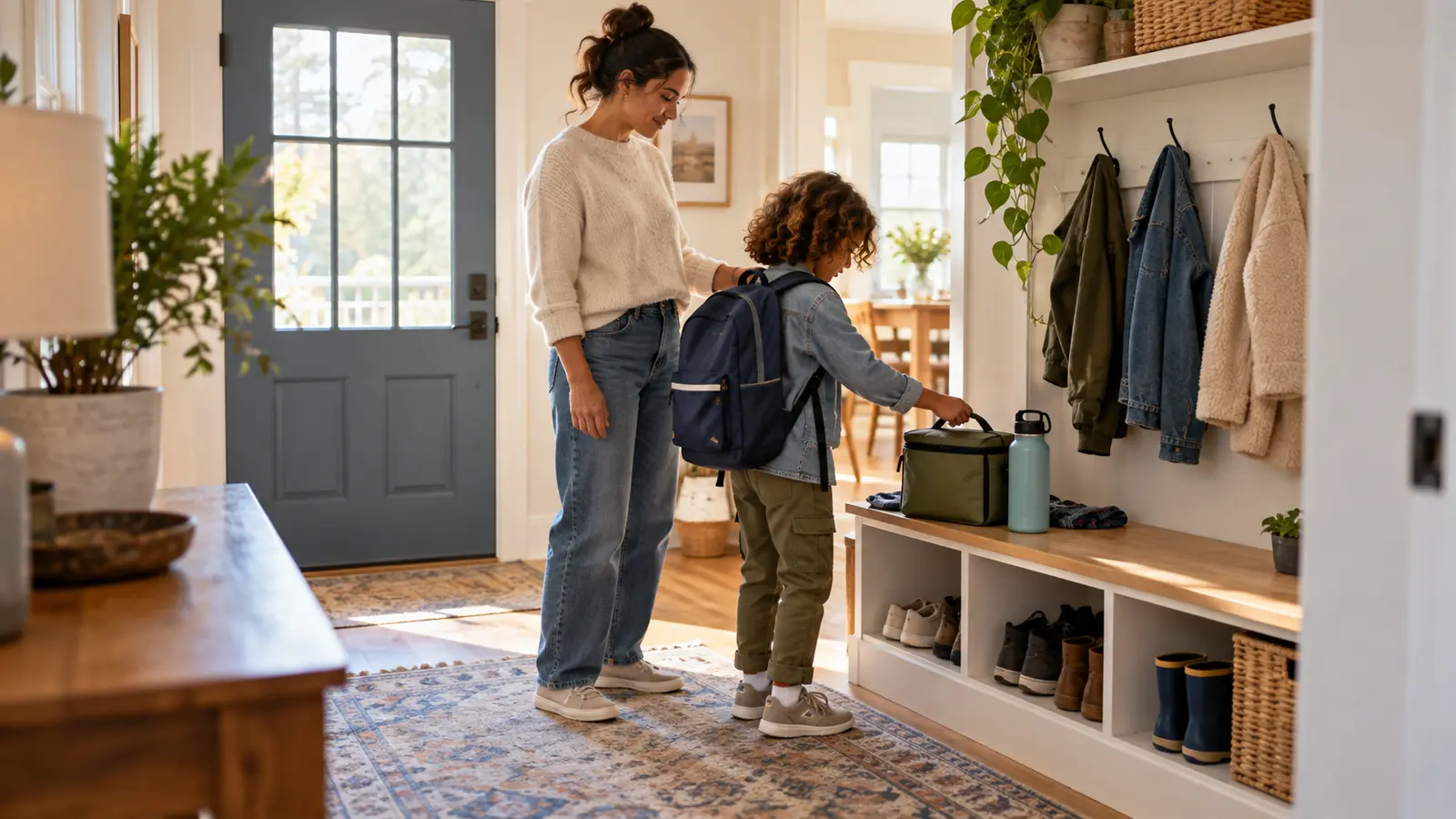
Short answer: make an ADHD morning routine easier by doing the thinking before the morning begins. Stage essential items in one visible “launch pad,” reduce the checklist to a few concrete actions, and use the same cues in the same places. The goal is a repeatable path that shows what happens next and gives the family a neutral way to recover.
Why “just get ready” is not one task
Leaving for school may sound like a single instruction, but it contains a chain of actions: wake up, shift activities, dress, eat, manage time, remember changing school requirements, find belongings, and depart. Each handoff creates another place to pause, become distracted, or forget the next step. A child can understand every action and still struggle to coordinate the sequence under time pressure.
The American Academy of Pediatrics advises families to organize and structure the home at a level the child can manage, using routines, limited choices, and written task lists when helpful. Harvard’s Center on the Developing Child describes executive function as the skills used to plan, focus, switch gears, and manage information. A morning system should therefore reduce how much information must be remembered at once; it should not depend on repeated verbal reminders.
Build the launch pad in five moves
Choose one landing-and-launch zone
Use a small area near the exit for the backpack, lunch bag, shoes, outerwear, and any item that must leave the house. Hooks, an open bin, or a simple bench can work. Keep it visible and easy to reach; a system hidden behind several doors may add friction.
Stage the morning the night before
The AAP’s family-routine guidance recommends putting as many things in order as possible the night before, and CHADD’s school-morning resource similarly suggests preparing clothes, school materials, lunch, and activity gear in advance. Define “ready”: bag packed, device charging, clothes selected, water beside lunch, and special-event items at the door.
Create a short visible sequence
Limit the morning checklist to essential actions. A younger child might use four pictures: dress, eat, bathroom, launch pad. An older child may prefer five written steps. Place each cue where the action begins rather than on a crowded family command center. If a checklist has fifteen items, combine related actions or move nonessential chores to another time.
Use landmarks, not a stream of warnings
Choose two or three predictable transition cues: breakfast ends, shoes go on, then a final launch-pad check. A timer may help, but pair it with the next action rather than merely announcing that time is disappearing. Try “when this ends, start shoes” instead of repeating “we’re late.” Keep the cue neutral and consistent enough that it becomes part of the routine.
Teach a recovery step
Even a useful routine will break sometimes. Agree on one reset: stop, look at the visible sequence, identify the next unfinished action, and resume there. If something is missing, use a designated backup plan rather than searching every room. Recovery is part of the system—not evidence that the child or parent has failed.
Make prompts smaller and more useful
A broad prompt such as “What are you supposed to be doing?” asks the child to reconstruct the entire plan. Point to the cue or name one observable action: “Check the next picture,” “Shoes are next,” or “Put the lunch bag beside the backpack.” Then allow a brief pause. Stacking several questions and corrections can make it harder to identify which action matters now.
Offer limited choices where flexibility is real: blue shirt or green shirt, breakfast option A or B. Do not offer a choice when the family cannot accept either answer. The AAP notes that predictable routines and limited choices can make daily expectations more manageable. The purpose is not to remove the child’s agency, but to place decisions where they fit without turning every step into a negotiation.
Test the routine like a design, not a character judgment
Test the plan for five school mornings. Note the first delay, which prompt helped, what was missing, and whether the family left with essentials. Avoid grading the child’s attitude or demanding a flawless streak.
At the end of the week, ask the child two concrete questions: “Which part was easiest to follow?” and “Where did the plan stop helping?” Change one feature at a time. You might move the shoe bin, shorten the picture sequence, prepare sports gear earlier, or remove a timer that increases stress. Individualize the support: some children prefer photos, others words, and some need rehearsal with a parent.
A practical evening-and-morning checklist
The night before
- Check the school calendar once for tomorrow-only items.
- Pack the bag and place it in the launch zone.
- Stage lunch, water, clothes, shoes, and outerwear.
- Confirm one departure time and any shared transportation plan.
In the morning
- Follow the same short visible sequence.
- Give one next-action prompt, then pause.
- Use a planned transition cue for shoes and departure.
- Complete one launch-pad scan before leaving.
- If the plan breaks, return to the next unfinished action.
Frequently asked questions
Should parents prepare everything for a child?
No. Adults can provide the structure while giving the child meaningful, age-appropriate responsibility. Start by doing the sequence together, then gradually shift a step when the child can use the cue reliably. Independence is built through supported practice, not sudden withdrawal of help.
What if the visual checklist is ignored?
Check whether it is short, placed at the point of action, and rehearsed when no one is rushed. Invite the child to choose photos, wording, or placement. If the list becomes background decoration, simplify it and pair it with one consistent prompt.
Are rewards required for a morning routine?
Not always. Clear cues, predictable sequencing, specific positive feedback, and reduced friction may be enough. If reinforcement is used, define one achievable behavior and consult a qualified professional when it is part of treatment.
Does a difficult morning mean ADHD treatment is not working?
No single morning can answer that question. Sleep, schedule changes, illness, task demands, and many other factors can affect functioning. Discuss persistent concerns or meaningful changes with the child’s healthcare professional rather than changing treatment on your own.
Sources
- American Academy of Pediatrics: Simplifying, Organizing, and Structuring the Home Environment for Children with ADHD (updated December 18, 2025)
- American Academy of Pediatrics: The Importance of Family Routines (updated June 28, 2024)
- CHADD National Resource Center on ADHD: Tips for Creating a School Morning Routine (CDC-supported resource; accessed October 4, 2026)
- Center on the Developing Child at Harvard University: A Guide to Executive Function (accessed October 4, 2026)