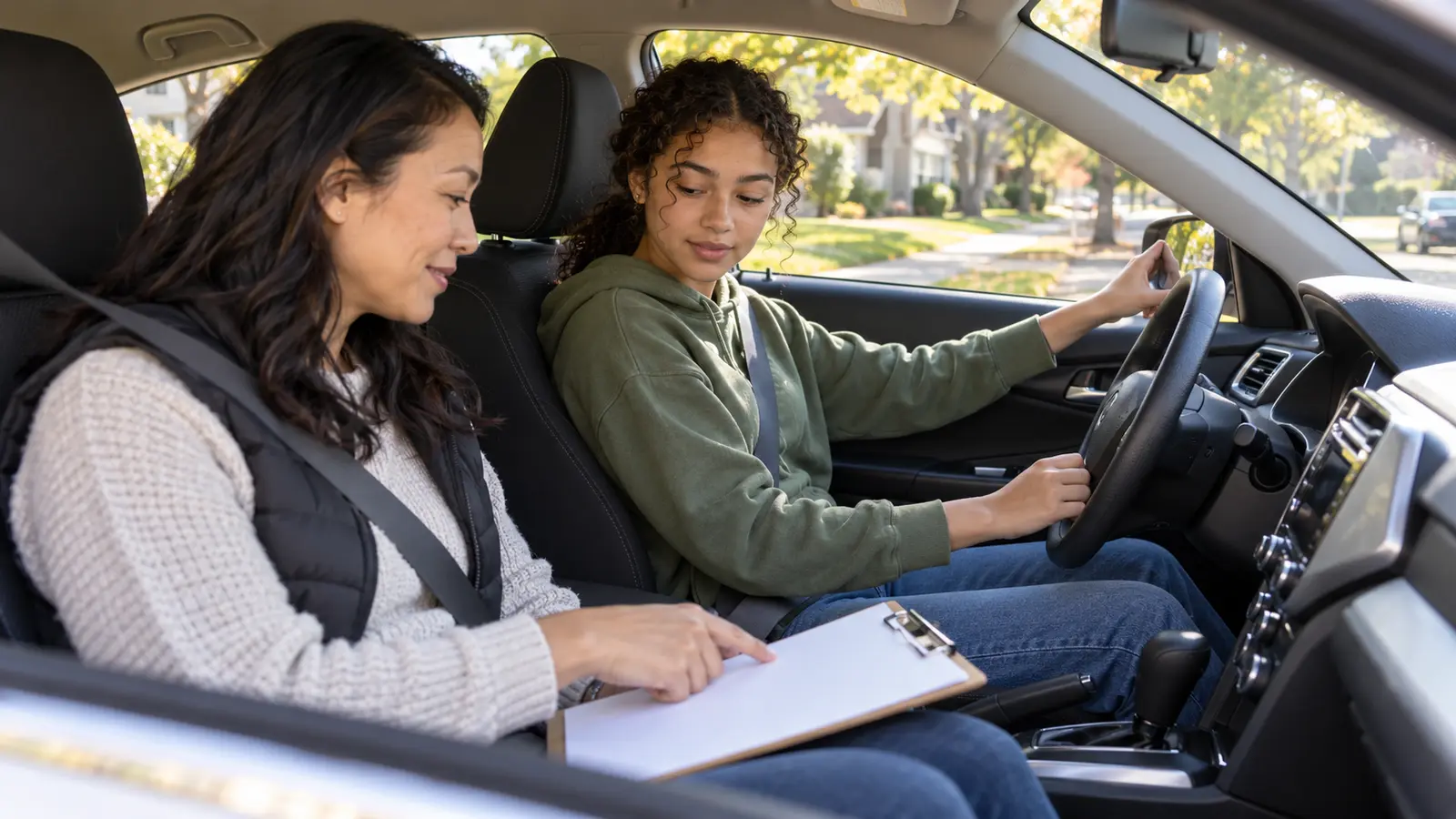
Short answer: Safer driving for a teen with ADHD is built through gradual, supervised practice—not a single conversation about “being careful.” Start in low-demand settings, teach a repeatable pre-drive routine, remove avoidable distractions before the car moves, use written family rules, and review one observable skill after each drive. Readiness is individual, and licensing should never be treated as an automatic milestone.
Why a structured plan matters
Driving combines sustained attention, rapid decisions, working memory, impulse control, and awareness of changing conditions. ADHD does not make every teen an unsafe driver, but group-level research shows a reason to plan deliberately. A 2019 cohort study of 14,936 newly licensed New Jersey drivers found higher crash, violation, and suspension rates among drivers with ADHD; the difference was especially pronounced in the first month of licensure. An earlier study from the same research group found a 36% higher hazard of a first police-reported crash among young drivers with ADHD.
Those findings describe populations, not the future of one teenager. They also do not identify a single cause. The useful response is neither panic nor reassurance without evidence. It is to make practice conditions, rules, feedback, and progression visible.
Build a five-part practice plan
Begin with readiness, not age alone
Before practice starts, discuss whether the teen can follow household safety rules, accept immediate coaching, communicate when overwhelmed, and stop when conditions exceed current skill. Review vision, sleep, substance use, emotional distress, and any health concern that could affect driving with an appropriate professional. The American Academy of Pediatrics identifies driving as a special safety concern for adolescents with ADHD. Questions about medication timing, effects, or side effects belong with the prescribing clinician—not a driving instructor or online checklist.
Use a low-to-high complexity ladder
Begin in an empty lot or another lawful, low-demand setting, then progress to quiet streets, familiar intersections, moderate traffic, highways, darkness, and poor weather only after earlier skills are reliable. Repeat the same route when teaching a new skill so navigation demands do not compete with steering, scanning, or speed control. The CDC and NHTSA describe graduated driver licensing as a way to add privileges while limiting exposure to high-risk conditions. Families should follow their own state’s current permit, passenger, nighttime, and supervised-practice rules.
Install a pre-drive reset
Use the same short sequence every time: seat and mirrors, seat belts, destination, phone stored, audio set, and one skill goal named. Navigation and music should be configured while parked. NHTSA identifies phones and teen passengers as important distraction risks for novice drivers. A routine reduces the need to remember separate instructions once the car is moving.
Write a parent-teen agreement
A useful agreement covers who may ride, when and where the teen may drive, phone and seat-belt rules, weather limits, check-in expectations, and a no-penalty rescue option if the teen feels unable to drive home safely. It should also explain what happens after a violation and how privileges can be rebuilt. CDC offers a parent-teen driving agreement specifically to make expectations and limits explicit. Keep family rules at least as strict as applicable law.
Debrief one skill, then stop
After parking, ask the teen to name one thing that went well and one situation that required extra effort. The supervising adult adds one specific observation and chooses one next practice target. Avoid a long list of every error; working memory is not improved by an overloaded post-drive lecture. Record the route, conditions, skill practiced, and next step in a simple log.
Teach attention as a driving behavior
“Pay attention” is not an actionable cue. Coaching should describe what the driver does with eyes, hands, speed, and space. For example: “mirror, signal, shoulder check,” “eyes back to the road,” or “increase following distance.” Use brief, consistent wording during the drive and save explanations for when the vehicle is safely parked.
A randomized trial published in 2022 tested a specialized computerized program for drivers ages 16–19 with ADHD. The program trained shorter glances away from the roadway and included feedback. Compared with enhanced conventional driver education, participants showed fewer long glances in simulation and a lower rate of collisions or near-collisions during recorded real-world driving. That result supports targeted skill practice; it does not mean any attention game or generic brain-training program produces the same effect.
Decide how privileges will expand
Do not base independence on a birthday, a minimum number of hours alone, or one good drive. Set criteria across several drives and conditions. A teen might demonstrate reliable pre-drive setup, scanning, speed control, lane position, response to coaching, and willingness to pause. Increase one variable at a time—perhaps an unfamiliar route before adding darkness or passengers—so the family can see what changed.
Pause or step back when the teen repeatedly breaks core rules, hides driving behavior, cannot accept safety instructions, drives while drowsy or emotionally flooded, or has a health or medication concern that has not been reviewed. A pause is a safety decision, not a moral verdict. Families can ask a pediatrician or another qualified clinician about readiness concerns and may consider a certified driving rehabilitation specialist when individualized assessment is needed.
Frequently asked questions
Should a teen with ADHD wait longer to get a license?
There is no universal age that is right for every teen. Readiness depends on demonstrated skills, judgment, adherence to rules, health, local law, and the ability to practice safely. A qualified clinician can help discuss individual concerns but does not replace the licensing authority or an on-road evaluation.
Does ADHD medication make driving safe?
No medication guarantees safe driving. The AAP advises clinicians to consider symptom coverage while driving, but medication choice, timing, benefits, and side effects require individualized discussion with the prescriber. Medication does not replace seat belts, distraction controls, supervised practice, or legal restrictions.
How much practice is enough?
Meet or exceed the legal minimum in your state, but use skill reliability rather than hours alone to guide progression. Practice across relevant environments while changing one difficulty at a time. More hours are not automatically better if practice is rushed, conflict-heavy, or poorly supervised.
What if parent and teen argue during practice?
Pull over safely and end the lesson if communication is interfering with driving. Agree on short coaching phrases before the next session, practice for less time, and consider a qualified professional instructor. The priority is safe learning, not winning the disagreement.
Sources
- Centers for Disease Control and Prevention: Protecting the Health of Children With ADHD (accessed October 6, 2026)
- CDC: Parent-Teen Driving Agreement (accessed October 6, 2026)
- National Highway Traffic Safety Administration: Parents—Talk to Your Teen Driver About Safe Driving (accessed October 6, 2026)
- American Academy of Pediatrics: ADHD Clinical Practice Guideline (Pediatrics, 2019)
- Curry et al.: Traffic Crashes, Violations, and Suspensions Among Young Drivers With ADHD (Pediatrics, 2019)
- Epstein et al.: Trial of Training to Reduce Driver Inattention in Teens With ADHD (New England Journal of Medicine, 2022)
- Children’s Hospital of Philadelphia: ADHD and Driving (accessed October 6, 2026)