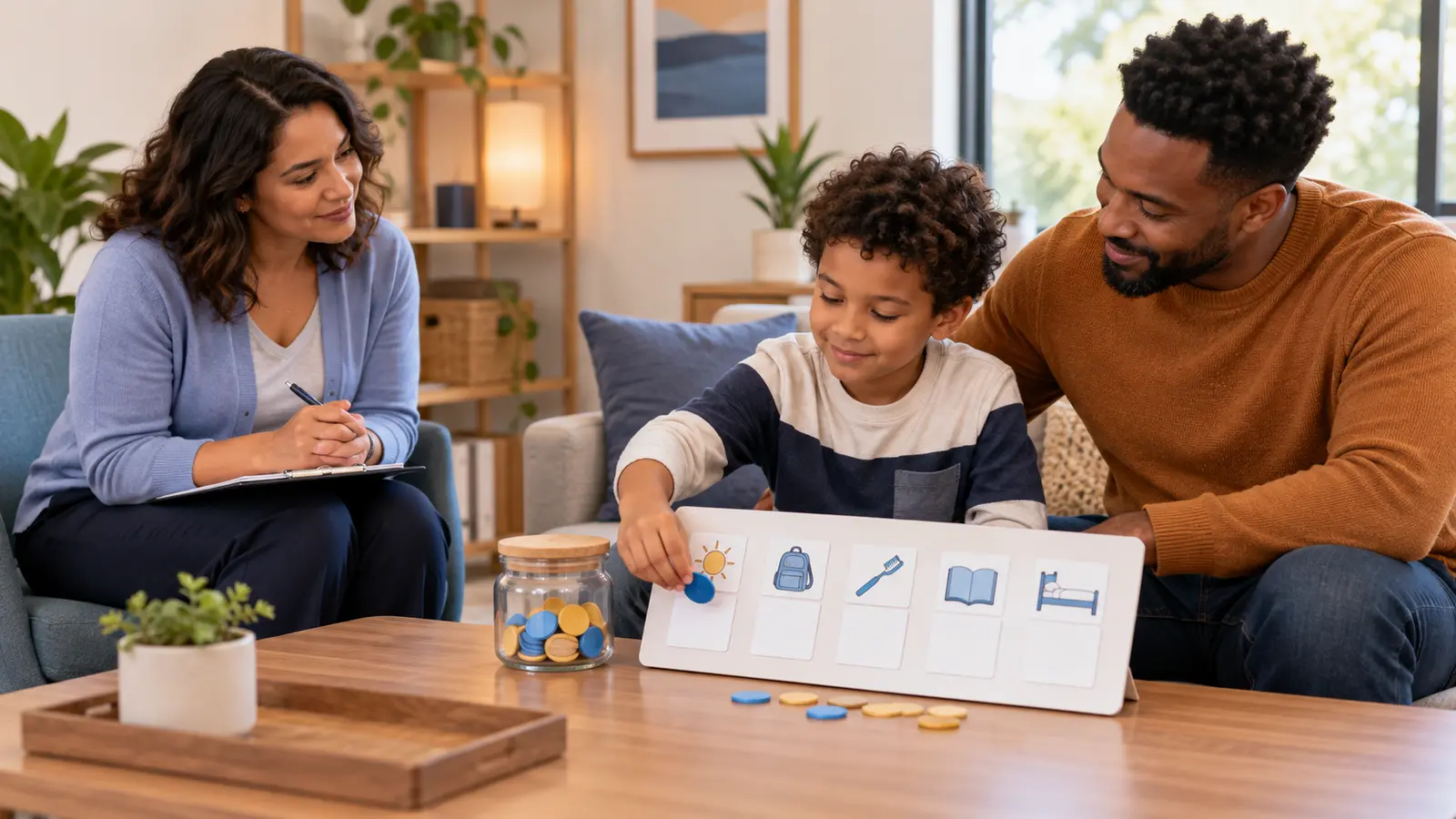
Direct answer: Behavioral parent training is a structured ADHD treatment in which a trained professional teaches caregivers practical behavior-management skills, then helps them practice and adjust those skills at home. Sessions commonly focus on positive attention, clear instructions, predictable routines, reinforcement, and consistent responses. The aim is not to “fix” a child or blame a parent. It is to build a home environment in which expectations and feedback are easier to understand.
Why the parent is in the training
Young children use adult support to organize behavior. A therapist may see a child for an hour, but caregivers guide transitions, homework, meals, play, and bedtime across the week. Training therefore gives the adult tools to use where difficulties actually occur.
The Centers for Disease Control and Prevention describes parent training in behavior management as an effective ADHD treatment and the recommended first choice for children under age 6. CDC also explains that the approach builds parenting skills, strengthens parent-child interaction, and helps children manage behavior. For school-age children, treatment planning may combine behavioral work with medication, classroom support, or other services according to individual needs.
What a solid program usually teaches
Observe before choosing a strategy
Instead of starting with “My child never listens,” the clinician helps define one situation: what happens before the behavior, what the child does, and what follows. “After screen time ends, three verbal directions arrive while the backpack is still unpacked” is easier to change than a global label.
Families may choose one target that matters in daily life, such as beginning the bedtime routine after one reminder. A narrow target makes practice measurable without turning the home into a constant behavior chart.
Make the expected behavior visible
Caregivers practice short, specific directions and check that the child can do the requested action. “Shoes in the basket, please” gives a clearer starting point than “Get organized.” A provider may help the family build a picture routine, break a transition into steps, or reduce competing instructions.
Catch useful behavior early
Positive reinforcement means noticing and responding to a behavior the family wants to strengthen. Feedback works best when it is prompt and specific: “You put the tablet down when the timer ended,” rather than a vague “Good job.” Some plans use points or small rewards; others rely mostly on attention, choices, privileges, or shared activities.
Respond consistently without humiliation
Programs may teach planned consequences, selective attention to minor behavior, or brief removal of a privilege when appropriate. The exact tool depends on the behavior and the program. It should be explained in advance, applied calmly, and proportionate to the situation. Physical punishment, shaming, threats, and public charts that expose a child are not required features of evidence-based parent training.
Repair also matters. Adults will occasionally give an unclear direction or react too sharply. A good plan allows the parent to reset, name the mistake, and try again.
What the first visits may look like
CDC says parents typically attend 8–16 sessions, although the format and duration vary. A first visit may review the child’s evaluation, family priorities, strengths, routines, school context, safety concerns, and other conditions that can affect behavior. Later sessions often include teaching one skill, watching or role-playing it, choosing home practice, reviewing what happened, and adjusting the plan.
Look for active coaching rather than advice alone. CDC recommends asking whether the therapist teaches positive reinforcement, structure, consistent discipline, and positive communication; assigns practice; monitors progress; and revises the plan when needed. The Society of Clinical Child and Adolescent Psychology also lists behavioral parent training among the evidence-based non-medication approaches for children and adolescents with ADHD.
Five questions to ask a provider
Bring these to the first call
- Which parent-training model do you use, and what ADHD-specific training or supervision have you completed?
- How will we choose a small, observable goal and track whether the plan is helping?
- Will you coach us while we practice, or mainly offer general advice?
- How do you adapt for learning, language, sensory, sleep, anxiety, trauma, or caregiver-access needs?
- How will you coordinate with our child’s clinician and school when consent and coordination are appropriate?
The American Academy of Pediatrics’ clinical guideline recommends parent training in behavior management and/or behavioral classroom interventions as first-line treatment for preschool-aged children with ADHD. For children age 6 and older, the guideline recommends medication alongside parent training and/or classroom behavioral intervention, preferably with both home and school supports when available. A healthcare professional should help families apply age-based guidance to the child’s complete clinical picture.
How to judge progress without demanding perfection
Choose outcomes that can change before symptoms disappear: fewer repeated directions during one routine, a shorter transition, more positive parent-child interactions, or faster recovery after conflict. Track one or two measures for a few weeks. Improvement may be uneven, and a difficult day does not invalidate the plan.
If there is no meaningful progress, review the target, the consistency and feasibility of the strategy, and possible barriers such as sleep problems, anxiety, learning needs, medication effects, family stress, or an unrealistic demand. The National Institute of Mental Health notes that children’s treatment can include parent education, behavioral interventions, medication, and school programs. Parent training can be valuable without being the entire treatment plan.
Frequently asked questions
Does behavioral parent training mean my child does not attend?
Often the main learner is the caregiver, especially with younger children. Some programs include the child for observation, coaching, or family practice. Ask how the program is structured and why that format fits your child’s age and needs.
Is this the same as ordinary parenting advice?
No. A good program uses a defined approach, teaches specific skills, includes practice and feedback, and monitors meaningful outcomes. General encouragement can be helpful, but it is not the same as structured treatment.
Does parent training replace ADHD medication?
Not automatically. Recommendations differ by age, impairment, co-occurring conditions, family preferences, and response to treatment. Discuss medication and behavioral options with a qualified healthcare professional rather than stopping, starting, or changing treatment based on an article.
What if the plan increases conflict?
Tell the provider promptly. The goal, demand, reward, consequence, or delivery may need adjustment, and another condition or stressor may need attention. Seek urgent professional help for safety concerns, severe aggression, self-harm, or a rapidly worsening situation.
Actionable takeaways
- Ask for a program that teaches and coaches concrete caregiver skills.
- Start with one routine and one observable behavior, not the child’s whole day.
- Use specific positive feedback more often than broad criticism.
- Track whether daily functioning and family interactions improve.
- Keep the plan connected to the child’s healthcare and school supports.
Sources
- Centers for Disease Control and Prevention: Parent Training in Behavior Management. Updated June 1, 2026; reviewed July 30, 2026.
- American Academy of Pediatrics: Clinical Practice Guideline for the Diagnosis, Evaluation, and Treatment of ADHD in Children and Adolescents. Pediatrics, 2019.
- Society of Clinical Child and Adolescent Psychology: Inattention & Hyperactivity (ADHD). Evidence-based therapy overview, updated March 6, 2024.
- National Institute of Mental Health: Attention-Deficit/Hyperactivity Disorder—What You Need to Know. Treatment and parent-support overview.