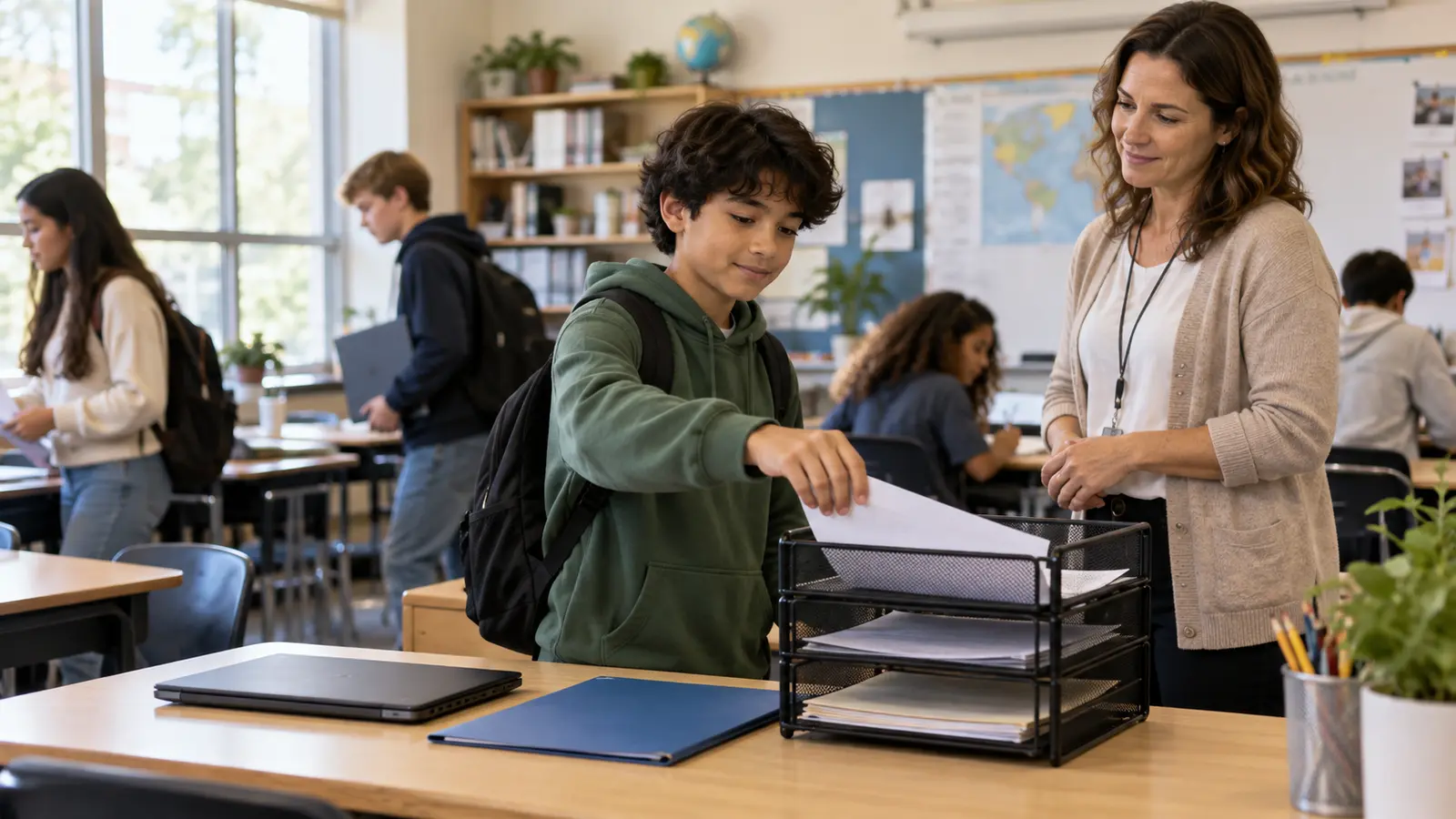
Short answer: when a student finishes work but does not submit it, treat completion and handoff as separate steps. Choose one submission path, make the final action visible, add brief proof that the handoff happened, and teach a calm recovery routine for mistakes. The goal is not perfect memory. It is a school system that makes the next action easier to see and repeat.
Why “done” is not the same as “delivered”
An assignment can be accurate, complete, and still remain in a backpack, drafts folder, email outbox, or the wrong learning platform. That last gap may look small to an adult, but it can require several executive actions: noticing the work is complete, remembering the destination, switching screens or locations, locating the correct course, checking the file, pressing submit, and confirming that the system accepted it.
ADHD can involve difficulty staying organized, following through, managing time, and remembering assignments or other daily tasks. Those features do not prove why one particular paper was missed, and a forgotten submission should never be used to diagnose a student. They do explain why a reliable handoff can be more useful than repeated reminders to “be responsible.”
Build one clear handoff path
Define the finish line
Write the final action into the assignment itself. “Complete questions 1–10” describes the academic work. “Complete questions 1–10, place the paper in the blue tray, and mark it submitted on the checklist” describes the whole process. For digital work, name the exact platform, course, assignment, file type, and confirmation cue.
Reduce the number of destinations
A student should not have to guess whether work belongs in a tray, on a desk, in an email, or in one of several apps. Use one routine per class whenever possible. If the platform cannot be simplified, provide a small course-specific map: “Math → Classroom → Classwork → Week 6 → Submit.” Organizational support is most effective when it removes a real decision rather than adding another system to remember.
Make completion observable
Use a quick proof that answers, “How do I know it arrived?” For paper, the proof might be an empty “to turn in” pocket after the student visits the tray. For digital work, it might be the platform’s “submitted” status, a timestamp, or moving the task to a short completed list. Avoid requiring screenshots of every assignment unless that is genuinely necessary; proof should lower uncertainty, not create a second assignment.
Protect a two-minute closeout
Reserve the final two minutes of class or study time for handoff rather than beginning a new demand. The student checks three things: Is the work complete enough to submit? Is it in the correct destination? Is there visible confirmation? A consistent closeout cue can be verbal, visual, or built into the classroom schedule.
Use parallel paper and digital routines
Paper handoff
- Finished work goes immediately into one front pocket or transparent folder.
- The folder stays visible until the paper reaches the classroom tray.
- After delivery, the student clears the pocket during closeout.
- Unfinished work goes somewhere different, so “needs work” and “ready to turn in” cannot be confused.
Digital handoff
- Use a stable file name that includes the class and assignment.
- Open the assignment from the teacher’s posted link rather than searching from memory.
- Attach or upload the file, then open it once to confirm it is the intended version.
- Press submit and check for the platform’s confirmation state before closing the tab.
CAST’s Universal Design for Learning guidance recommends scaffolding planning, organizing information and resources, and monitoring progress. These supports can benefit many learners. A student with an individualized plan may also need specific accommodations or services determined through the school’s formal process.
Teach recovery without shame
No handoff system will work perfectly. Build the recovery path before the next mistake:
- Locate: Find the paper, file, draft, or platform record.
- Verify: Check whether the work is complete and whether a submission attempt occurred.
- Deliver: Use the normal handoff path, or the teacher’s stated late-work path.
- Repair one link: Change only the step that failed—destination, reminder, file naming, or confirmation.
A recovery conversation should be brief and factual. The student still needs appropriate expectations and accountability, but public correction, sarcasm, or removing every opportunity for independence can make the system harder to use. CDC classroom guidance emphasizes clear assignments, positive feedback, advance notice around transitions, and individualized planning rather than a one-size-fits-all response.
Review the system for two weeks
Track a few ordinary outcomes, not a global judgment about motivation:
- How many assignments were completed?
- How many completed assignments reached the correct destination?
- At which step did missed handoffs occur?
- How much adult prompting was required?
- Could the student recover independently after noticing an error?
If the same step fails repeatedly, revise that step. More reminders are not automatically better. One well-placed cue at the point of handoff may work better than several reminders given earlier, when the student cannot yet act.
When to consider formal school support
Persistent submission problems can affect access to instruction, grading, and participation. The American Academy of Pediatrics states that educational interventions and individualized instructional supports are a necessary part of treatment planning for school-age children and adolescents with ADHD. In the United States, eligible students may receive supports through an IEP or Section 504 plan; eligibility and services require individualized evaluation and vary by student. Families can bring concrete examples of completed-but-missing work, platform records, and data from a short handoff trial to the school team.
Actionable takeaways
- Separate “finish” from “submit” in instructions and checklists.
- Use one destination per class whenever possible.
- Build in a visible confirmation cue.
- Reserve two minutes for closeout.
- Teach a four-step recovery routine before problems occur.
- Review one failing link instead of labeling the student.
Frequently asked questions
Should parents check every submission?
Usually, the better long-term goal is a system the student can increasingly operate. Temporary adult checks may help while a routine is being taught, but decide when and how support will fade. Some students will continue to need individualized assistance.
What if the student says they submitted the work?
Check the platform status, timestamp, paper tray, or file together without turning the conversation into an interrogation. A draft may have been saved but not submitted, or the wrong file may have been attached. Find the failed step and repair it.
Is late work always an ADHD issue?
No. Unclear instructions, inaccessible technology, workload, absence, learning difficulties, stress, sleep problems, or other factors may contribute. Patterns across settings should be discussed with appropriate school and healthcare professionals rather than assumed from one behavior.
Should a teacher accept every missed assignment without a deadline?
Not necessarily. Clear deadlines and predictable policies can support learning. The question is whether the student can access and use the submission process and whether an individualized accommodation or recovery window is appropriate.
Sources
- National Institute of Mental Health: Attention-Deficit/Hyperactivity Disorder—What You Need to Know
- Centers for Disease Control and Prevention: ADHD in the Classroom (updated June 1, 2026)
- American Academy of Pediatrics: Clinical Practice Guideline for ADHD in Children and Adolescents
- U.S. Department of Education: Parent and Educator Resource Guide to Section 504
- CAST: UDL Guidelines—Strategy Development